The drift I could feel but not see
When I write quickly, something slips. My sentences get longer. I drop my contractions. I start hedging with phrases I would never say out loud. I can feel that the words on the page are not quite mine, but I could never point at the exact thing that changed.
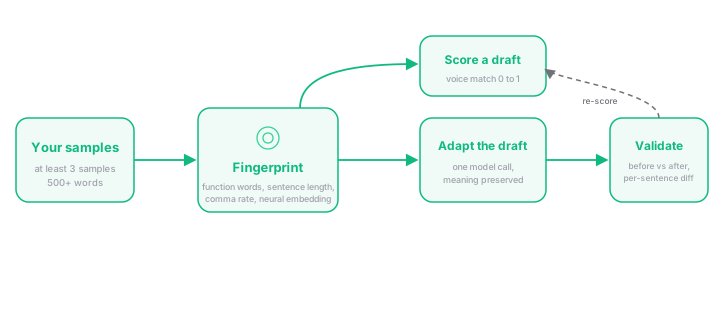
VoicePrint is my attempt to put a number on that feeling. You give it a few samples of your own writing. It measures your voice as a set of habits, scores how far any new draft has drifted, and then nudges the draft back toward you. There is a live demo if you want to try it.
One thing up front: this is about measuring and matching your own voice. It is not about imitating anyone else. The target is a positive one you can inspect, which is the writing you already do when you are not in a hurry.
Style is not what you say, it is how you say it
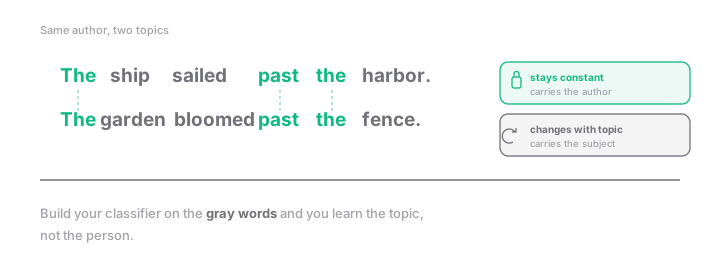
Here is the single most important idea, and it is the one that surprises most people new to this. If you want to identify who wrote something, the worst signals are the interesting words: the nouns, the verbs, the topic. Those track the subject matter, not the writer.
Think about two essays by the same author, one about sailing and one about gardening. On content words they look like two different people, because one is full of ships and one is full of flowers. The author has not changed. The topic has.
The signal that actually identifies a writer is the stuff they never think about: the small connective words and the rhythm underneath the sentence.
A fingerprint is a profile of habits
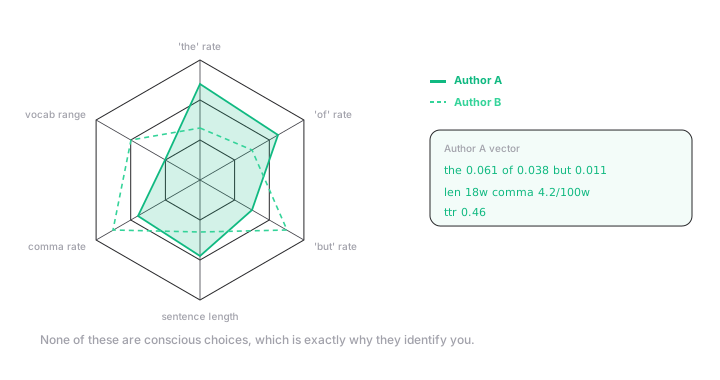
So what is a writing fingerprint, concretely? It is a set of measurable habits. Things like:
- How often you reach for function words like
the,but, andhowever - Your average sentence length
- How frequently you use commas and semicolons
- How wide your vocabulary range is across a passage
None of these are conscious choices. You do not decide your comma rate before you write. That is exactly why they identify you. And because every one of them is just a number, the whole fingerprint becomes a vector you can look at and compare coordinate by coordinate.
The honest test: train on one book, grade on another
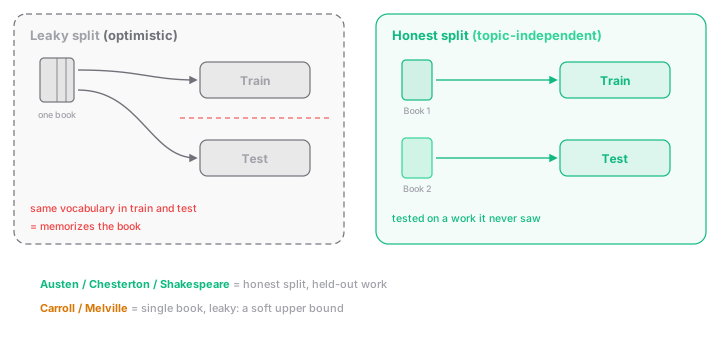
This is the methodology lesson that took me the longest to respect: topic leakage. Suppose you take one book, chop it into random chunks, throw some chunks into your training set and the rest into your test set. A classifier will score beautifully. But it won, because it memorized that one book's vocabulary. You have learned nothing about whether it can recognize the author anywhere else.
The fix is to split by work. Train on some of an author's books, then test on a completely different book they wrote that the model has never seen. If it still recognizes them, that is real.
I want to be upfront here. In my evaluation set, two of the five authors only had a single book available. Their scores test on the tail end of that one book, so they leak topic. Treat those two as a soft upper bound, not as honest cross-book performance.
The one number I trust, and the one I do not
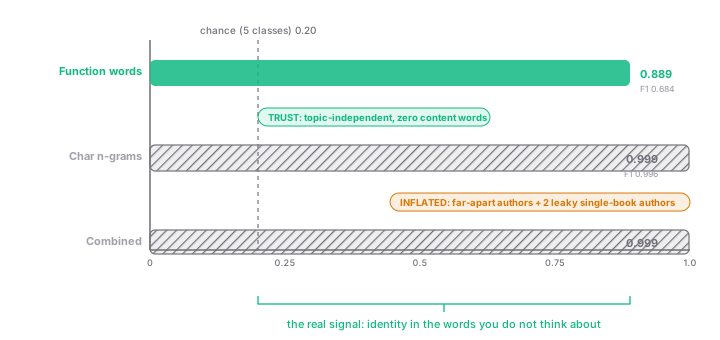
Now the results, with honest framing. Using function words alone, with zero content words, the model separated five authors at a macro-F1 of 0.684 and an accuracy of 0.889. With five classes, random guessing would land around 0.20. So this is far above chance, and it got there without ever looking at a single topic word.
That is the number I trust. It is the whole thesis of stylometry in one result: identity lives in the words you do not think about.
There is also a character n-gram model that scored 0.996 macro-F1 (0.999 accuracy). Please do not quote that as general accuracy. It is inflated. Five authors who write nothing alike, plus two who leak topic from a single book, make this task much easier than real open-world authorship attribution. The high number is a property of the easy set, not a property of the method.
Where function words fail (and why that is fine)
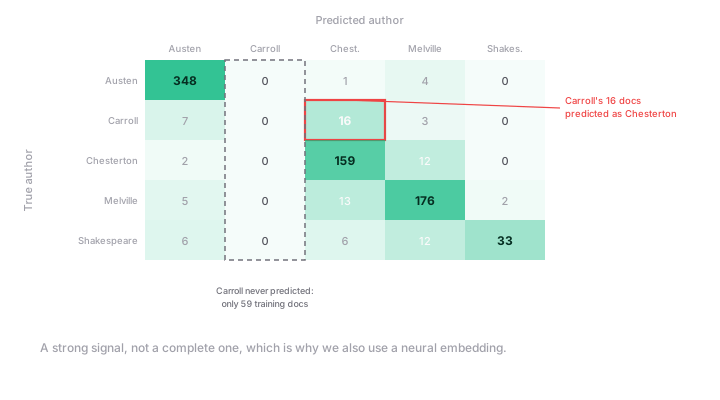
Here is the failure case, because you should not trust anything else I say if I hide it. Under function words alone, the model confused one author for another. It labeled 16 of Carroll's test documents as Chesterton, and it never once predicted Carroll for anything.
The reason is simple. Carroll had the fewest training documents, only 59. The model never gathered enough of his writing to carve out a region for him, so it folded him into his nearest dense neighbor. Function words are a strong signal. They are not a complete one. That gap is exactly why VoicePrint does not stop here and also uses a neural embedding.
The neural fingerprint catches what counts can't
Hand-counted features are honest and easy to read, but they miss a lot of what makes a voice feel like a voice. So I add a learned embedding on top.
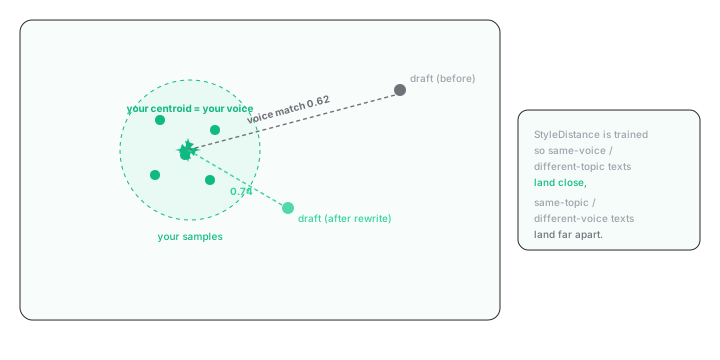
VoicePrint uses StyleDistance, a 2024 style embedding trained on a clever idea: texts in the same voice but on different topics should land close together, and texts on the same topic but in different voices should land far apart. That is the fingerprint property, learned directly.
The mechanics are friendly. You embed each of your samples into a point. You average those points into one center, called a centroid, which represents your voice. Then the voice match of any draft is just its cosine similarity to that centroid, a score from 0 to 1. You do not need the math. Closer means more like you.
Adapting a draft is rewriting, not generating
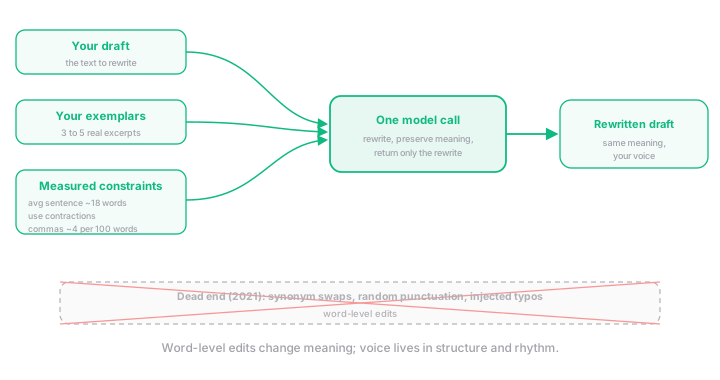
Once you can measure voice, moving a draft toward it becomes a rewriting problem. The meaning stays fixed. Only the style moves. That framing matters, because it rules out a lot of bad ideas.
VoicePrint does this in one model call that gets three things at once:
- The draft to rewrite
- Three to five real excerpts from your own writing, used as examples of how you actually sound
- Your measured profile, turned into plain-English rules like "keep sentences around 18 words," "use contractions," and "use commas at this rate"
The instruction is strict: rewrite while preserving meaning, and return only the rewrite. I tried the older 2021-style approach first, which swapped synonyms, scattered punctuation, and injected typos. That was a dead end. Those edits change meaning and just damage the text. Voice does not live in a thesaurus lookup. It lives in structure and rhythm.
Proving the rewrite actually helped
A rewrite is only useful if it moves your voice without losing your meaning. So VoicePrint measures both. It scores voice match before and after against your centroid, and it checks meaning against your own draft rather than some outside reference.
It also produces a per-sentence diff. Each sentence is labeled improved, regressed, or the same, with a small dead zone so that tiny wobble does not flip a label one way or the other. An honest sentence-by-sentence picture tells you far more than one feel-good number on top.
Limits and the honest framing
I want the caveats to stay as visible as the wins.
- The evaluation set is tiny, only five authors, and it is not open-world accuracy. Real attribution across thousands of writers is much harder.
- Two of those authors leak topic from a single book, so their scores are a soft upper bound.
- The rewrite is only as good as the model you bring to it, with a conservative rule-based fallback when needed.
- Authorship signals are probabilistic. A high voice match is evidence, not proof.
Most of all: this is voice adaptation on your own writing. The target is a positive one you can read, measure, and argue with. It is not impersonation, and it is not working against anything. The number that matters is 0.889 accuracy from function words alone, because it shows that the part of your writing you never think about is the part that is most yours. The code is on GitHub, and you can try the demo.